A Solitary Confinement
A true story about Guillain-Barre Syndrome by
Robin Sheppard
A true story about Guillain-Barre Syndrome by
Robin Sheppard
August, 2026
Guillain-Barré syndrome (GBS) is diagnosed through a combination of medical history, physical examination, neurological assessment, and specialised tests. There is no single test that confirms GBS, so doctors look for a pattern of symptoms alongside findings from nerve conduction studies, lumbar puncture, and other investigations to rule out similar conditions.
Key Takeaways
When someone begins experiencing unusual tingling, weakness, or difficulty walking, one of the biggest concerns is identifying the cause as quickly as possible. Because Guillain-Barré syndrome (GBS) can worsen over hours or days, obtaining an accurate Guillain-Barré diagnosis is critical.
Doctors don’t rely on a single laboratory test to diagnose GBS. Instead, they build a complete clinical picture by assessing symptoms, performing neurological examinations, and ordering specialised tests.
If you’ve already read our guide explaining what triggers GBS and its possible causes, understanding the diagnostic process is the next step toward recognising how the condition is identified and treated.
GBS is an autoimmune condition in which the immune system mistakenly attacks the peripheral nerves. As nerve damage progresses, muscle weakness can spread from the legs to the arms and, in severe cases, affect the muscles used for breathing.
Because symptoms can develop rapidly, doctors treat suspected GBS as a medical emergency.
Early diagnosis allows healthcare teams to:

The diagnosis begins with listening carefully to the patient’s symptoms and how they developed.
Doctors typically look for:
One important clue is that symptoms usually affect both sides of the body, making the pattern different from many other neurological disorders.
Your doctor will also ask about recent infections, illnesses, or vaccinations because these can sometimes occur before GBS develops. Learn more about the condition itself in our guide to Guillain-Barré syndrome.
Although symptoms provide important clues, doctors usually perform several tests to strengthen the diagnosis and exclude other conditions.
A neurological exam assesses:
One hallmark finding is significantly reduced or absent tendon reflexes.
Nerve conduction studies measure how quickly electrical signals travel through the nerves. In people with GBS, damaged nerves often transmit signals much more slowly than normal, helping neurologists identify characteristic nerve damage.
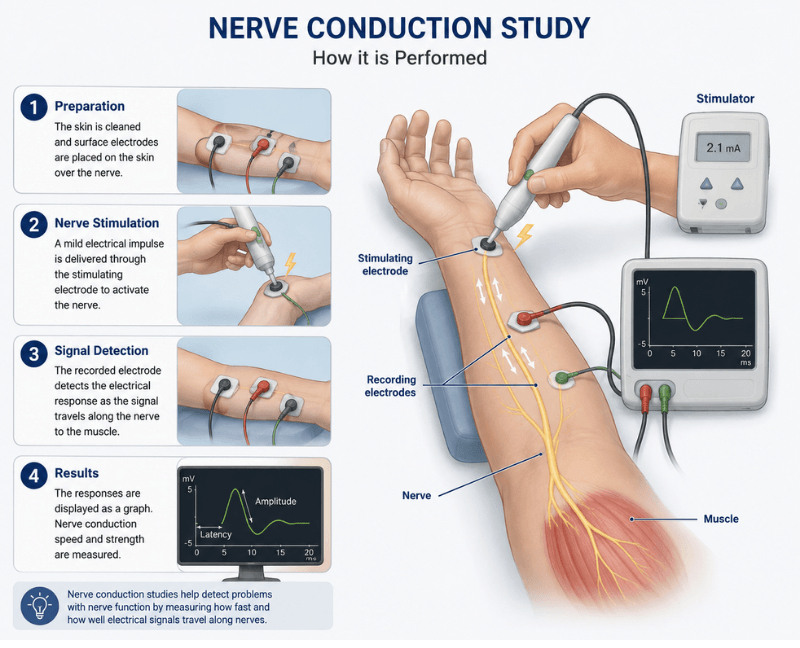
EMG may be performed alongside nerve conduction studies. This test measures the electrical activity inside muscles and helps determine whether weakness is caused by nerve damage rather than muscle disease.
A lumbar puncture involves collecting a small sample of cerebrospinal fluid (CSF).
Doctors commonly find:
| Finding | What It May Suggest |
| Elevated protein | Supports GBS diagnosis |
| Normal white blood cell count | Helps distinguish GBS from infection |
This pattern is often referred to as albuminocytologic dissociation, although it may not appear during the very early stages of the illness.
There is no blood test that directly confirms GBS.
However, blood tests help doctors exclude:
MRI scans do not diagnose GBS directly but may be ordered to rule out conditions affecting the spinal cord or brain that could cause similar symptoms.
Several neurological disorders may initially resemble GBS.
Doctors carefully distinguish GBS from conditions such as:
Because treatment differs for each condition, accurate diagnosis is essential.
Once doctors are confident that GBS is the cause of the symptoms, treatment usually begins immediately.
Most patients are admitted to a hospital where healthcare professionals monitor:
Treatment often includes immunotherapy, supportive care, and rehabilitation.
Recovery varies from person to person, but early intervention generally leads to better outcomes.
A diagnosis of GBS can feel overwhelming for both patients and families. While medical treatment focuses on recovery, hearing from someone who has personally experienced the condition can also provide reassurance and hope.
If you’re interested in a first-hand account of life with Guillain-Barré syndrome, Solitary Confinement: Always Paralysed From The Neck Downwards shares one individual’s journey through diagnosis, treatment, and recovery. It offers valuable insight into the emotional and physical challenges that many people affected by GBS can relate to.
A Guillain-Barré diagnosis involves much more than a single test. Doctors combine your medical history, symptoms, neurological examination, and specialised investigations to reach an accurate diagnosis while excluding other conditions.
Recognising the early signs and seeking urgent medical care can make a significant difference in treatment and recovery. If you’d like to understand more about Guillain-Barré syndrome, including its causes, symptoms, and recovery journey, explore our other educational resources. For those interested in a personal perspective, Solitary Confinement: Always Paralysed From The Neck Downwards offers a compelling account of living through GBS and the road to recovery.
How do doctors test for GBS?
Doctors test for GBS by combining a neurological examination with specialised investigations such as nerve conduction studies, electromyography (EMG), and a lumbar puncture. Blood tests and MRI scans may also be used to rule out other conditions.
Can one test confirm Guillain-Barré syndrome?
No. There is currently no single test that confirms GBS. Doctors diagnose the condition using a combination of symptoms, physical examination, and supporting test results.
How long does it take to diagnose GBS?
Some patients are diagnosed within hours after arriving at the hospital, while others may require additional testing over several days, particularly if symptoms are still developing.
Is GBS difficult to diagnose?
GBS can be challenging to diagnose early because its symptoms may resemble several other neurological conditions. As symptoms progress and test results become available, the diagnosis often becomes clearer.
Should I go to hospital if I think I have GBS?
Yes. Anyone experiencing rapidly worsening weakness, difficulty walking, numbness, or problems with breathing or swallowing should seek immediate medical attention. Early assessment is important because GBS can progress quickly.